
The Lie We Tell Ourselves
You are not lazy.
Let’s start there. You are not unmotivated, you are not weak, and you are not failing. Think about it, Maybe you are a person who has been running on empty for too long & your mind and body are finally staging an intervention.
The world tells us that if we just push harder, work longer, and sacrifice more, we will eventually earn the right to rest. But for the givers, the fixers, and the deeply responsible people of the world, this is a dangerous lie. It leads to a quiet, creeping exhaustion that feels like a personal failure.

You are not failing. You are experiencing burnout.Burnout is a state of emotional, physical, and mental exhaustion caused by prolonged or excessive stress. It is a serious condition that requires more than a weekend off; it requires a fundamental shift in how you live and how you care for yourself.
The Three Core Signs of Burnout
Burnout is often misdiagnosed as simple stress or depression. However, the World Health Organization (WHO) defines it by three distinct dimensions. If you recognize yourself in these three signs, you are not lazy—you are breaking.
1. Overwhelming Exhaustion (The Body’s Cry)
This is the most obvious sign, but it’s often the most misunderstood. This isn’t the tiredness you feel after a long day; it’s a profound, pervasive fatigue that no amount of sleep seems to fix.

- Physical Symptoms: You feel physically drained the moment you wake up. You have frequent headaches, muscle aches, or a constantly weakened immune system (you catch every cold).
- Emotional Symptoms: You feel emotionally flat. You can’t muster the energy for things you used to enjoy. You feel like you are moving through thick mud all day, every day.
- The Lie: You tell yourself, “I just need to push through this week, and then I’ll rest.”
2. Cynicism and Detachment (The Heart’s Defense)
This is the emotional shield your mind puts up to protect itself from the pain of constant depletion. You start to withdraw from your work, your relationships, and your life.

- At Work: You become cynical, irritable, and resentful. You start to view your colleagues or clients as problems rather than people. You feel like nothing you do matters.
- At Home: You become emotionally distant. You snap at loved ones easily, or you simply withdraw into silence. You feel disconnected from the people you care about most.
- The Lie: You tell yourself, “I’m just a negative person,” or “I’m just tired of people.”
3. Reduced Professional Efficacy (The Loss of Self-Worth)
This is the most painful dimension for the high-achiever. Despite working harder, you feel less effective. You struggle to concentrate, your memory is foggy, and you start to doubt your own competence.

- Symptoms: You miss deadlines, make simple mistakes, and find yourself procrastinating on tasks you used to handle easily. You feel a deep sense of failure and inadequacy.
- The Lie: You tell yourself, “I’m losing my touch,” or “I’m not good enough anymore.”
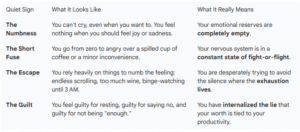
The Quiet Signs: Burnout Hiding in Plain Sight
Burnout doesn’t always look like a dramatic breakdown. Often, it hides in the small, quiet shifts in your daily life.
Burnout is a Boundary Problem
The core of burnout is often a lack of boundaries. You have allowed the demands of others to completely override your own needs. You are giving away your time, your energy, and your peace because you don’t know Setting Boundaries Without Guilt:
The Permission You’ve Been Waiting For.

Burnout is the ultimate signal that your boundaries have failed. It is your body’s way of forcing you to stop and say, “No more.”
Your First Step Toward Recovery
The path out of burnout is not about finding a new productivity hack; it is about finding a new way to exist. It starts with a single, radical act of self-compassion: giving yourself permission to rest.
- Acknowledge: Accept that you are burned out. This is not a moral failing; it is a medical and emotional reality.
- Pause: Find one thing you can stop doing today. It could be checking work emails after 6 PM, or taking on one less chore.
- Seek Peace: Begin to explore ways to quiet the noise. Your mind needs to learn how to be still again. This is where the gentle practice of Meditation for Beginners: A Gentle Introduction When Your Mind Won’t Quiet Down can be a powerful tool.

You are not lazy. You are a human being who has reached their limit. The most productive thing you can do right now is to begin your recovery.
Conclusion: You Are Worth the Pause
If you recognize these signs, please know this: You are not alone. Your exhaustion is real, and it is not your fault. The world needs your light, but it needs you to be whole first.The journey to peace begins with a single step of self-compassion. Give yourself the grace you would give to a friend. You are worthy of rest, worthy of peace, and worthy of a life where you are not constantly breaking.This article is part of a larger guide to reclaiming your mental peace. To understand the full picture of your exhaustion and begin your recovery, please read our Pillar Article: The Exhausted Soul’s Guide to Finding Peace: When Giving Everything Leaves You With Nothing.